In the previous two articles, we discussed silver-coated copper powder. Some readers then asked: If the silver-coated copper powder is synthesized in-house, is the copper powder itself also independently developed?
The answer is yes.
With many years of experience in copper powder preparation, Betely has accumulated extensive expertise in this field. Although copper powder production may appear simple, it actually involves significant technical barriers.
Depending on the preparation process, copper powder on the market can be classified into several types, including electrolytic, atomized, reduction, chemical, and mechanical methods.
Even though they are all copper powders, their performance can vary greatly when used in conductive pastes. In essence, the manufacturing process (“origin”) determines the powder’s performance characteristics (“personality”).
Copper Powder Preparation Processes: Different Methods, Different Properties
Different production processes result in variations in particle morphology, particle size, and surface condition, which ultimately influence the performance of conductive pastes.
Below is a summary of the core characteristics and typical applications of each production method:
Process | Typical Morphology | Key Advantages | Key Limitations | Main Applications |
Electrolytic | Dendritic | High conductivity, high purity | High energy consumption | Powder metallurgy, conductive materials, 3D printing |
Gas Atomization | Highly spherical | Excellent flowability | High cost | Metal Injection Molding (MIM), conductive materials |
Water Atomization | Near spherical | High output, low cost | Moderate sphericity | Conventional metallurgy, welding rods |
Reduction | Sponge-like | Low cost, good sintering | Poor flowability | Catalysts, metallurgical components |
Chemical Method | Ultrafine / nano | Small particle size, customizable, controllable cost | — | Conductive pastes, flexible electronics |
Mechanical Method | Flake / irregular | Simple process | High impurities | Low-end coatings, fillers |
For conductive paste applications, the powder material represents the first critical step. It typically requires:
Fine particle size
Uniform morphology
Active surface
Among all available processes, the chemical synthesis method best meets these requirements.
Betely Cu-H Series: Chemically Synthesized Copper Powder for Conductive Pastes
With more than 20 years of experience in conductive material development, Betely has consistently insisted on independent powder synthesis, covering products from silver powder to silver-coated copper powder and now copper powder.
The Cu-H series copper powder is synthesized using a chemical method, specifically designed for conductive paste applications. It offers four key advantages:
1. Uniform Particle Size
Particle size can be flexibly adjusted from submicron to micron levels, with a narrow distribution, making it easier to optimize conductive paste formulations.
2. High Sphericity
The powders exhibit excellent flowability, improving printing performance in paste applications.
3. Advanced Surface Treatment
An anti-oxidation modification is completed before shipment, leaving a sufficient processing window for downstream applications.
4. High Purity
Impurity levels are strictly controlled to avoid any negative impact on electrical conductivity.
Cu-H Series Product Specifications
To meet the needs of different conductive material applications, the Cu-H series includes four models with distinct particle sizes and physical properties.
Model | D50 (μm) | Tap Density (g/cm³) | Specific Surface Area (m²/g) |
Cu-H-07 | 0.6–0.9 | ≥3.0 | 1.1–1.6 |
Cu-H-20 | 1.8–2.4 | ≥3.5 | 0.5–0.7 |
Cu-H-30 | 2.7–3.6 | ≥4.0 | 0.28–0.42 |
Cu-H-40 | 3.6–4.5 | ≥4.0 | 0.16–0.36 |
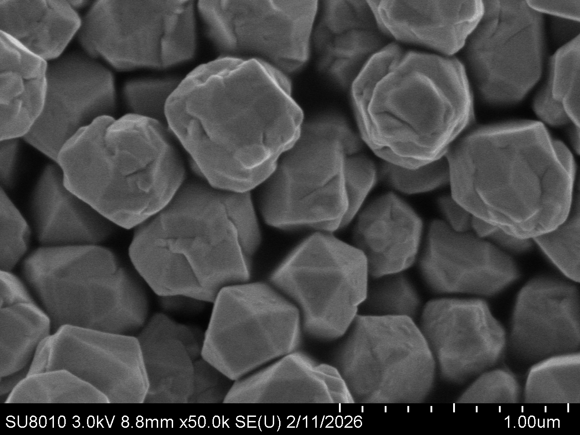
Cu-H-07
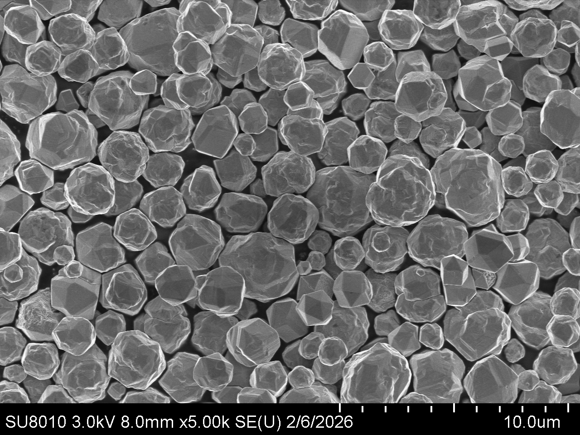
Cu-H-20
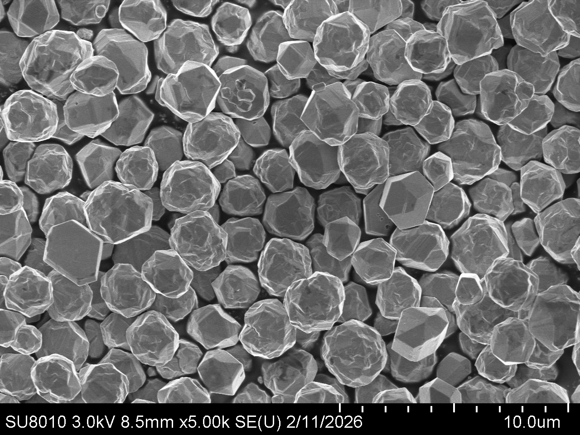
Cu-H-30
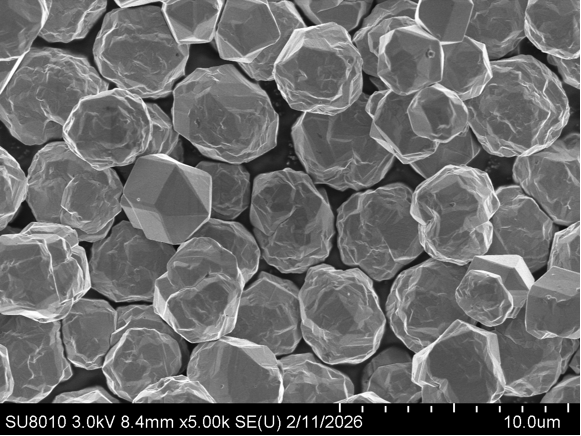
Cu-H-40
SEM Testing Information
Betely has also released SEM (Scanning Electron Microscope) inspection data for the Cu-H series powders.
Model | SEM Parameters |
Cu-H-07 | SU8010, 3.0kV, 8.8mm, ×50.0k, SE(U), Feb 11, 2026, 1.00 μm |
Cu-H-20 | SU8010, 3.0kV, 8.0mm, ×5.00k, SE(U), Feb 6, 2026, 10.0 μm |
Cu-H-30 | SU8010, 3.0kV, 8.5mm, ×5.00k, SE(U), Feb 11, 2026, 10.0 μm |
Cu-H-40 | SU8010, 3.0kV, 8.4mm, ×5.00k, SE(U), Feb 11, 2026, 10.0 μm |
Core Application Areas of the Cu-H Series
Copper powder has clearly defined application scenarios. The Cu-H series mainly targets four key sectors. Each application has slightly different performance requirements, which is why the series includes multiple particle size models to provide precise material selection for customers.
1. Photovoltaic Conductive Pastes
Compatible with silver-coated copper systems or pure copper systems.
2. PCB Through-Hole Metallization
Suitable for use in silver-coated copper or pure copper conductive systems in Printed Circuit Board Manufacturing.
3. Conductive Inks
Designed for flexible printed electronics.
4. Conductive Adhesives
Applied in electronic packaging and assembly processes.
Next Article Preview
This article introduced copper powder preparation processes and the product system of Betely’s Cu-H series copper powder.
In the next article, we will explore the microscopic world of the Cu-H series, including:
The precision of particle size distribution
The actual sphericity performance of the powders
The
— how oxidation resistance is balanced with electrical conductivity.