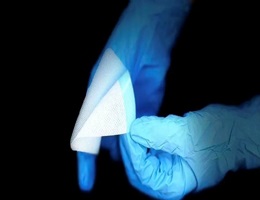
Slot-Die Coating: A Mainstream Process Upgrade for High-End Display Optical Bonding
In display optical bonding, patterned dispensing, gap filling, and slot-die coating are three of the most widely used adhesive application methods in the industry. As automotive displays and large-format commercial displays continue to demand higher bonding precision and greater mass-production efficiency, slot-die coating is increasingly becoming a preferred process for OCR optical bonding thanks to its core advantages of high precision, low material consumption, and excellent consistency, making it well suited to the production requirements of mid- to high-end display products.
The operating principle of slot-die coating is simple yet highly precise. The entire process relies on a dedicated coating head to apply the adhesive. The coating head consists of an upper die, a lower die, and a precision shim positioned between them. During production, the optical adhesive is uniformly extruded through the precisely controlled gap between the upper and lower dies, forming a stable adhesive bead at the bonding surface. The adhesive is then smoothly transferred onto the substrate to create a flat, uniform, and continuous wet film, ensuring stable adhesive-layer formation from the beginning of the process.
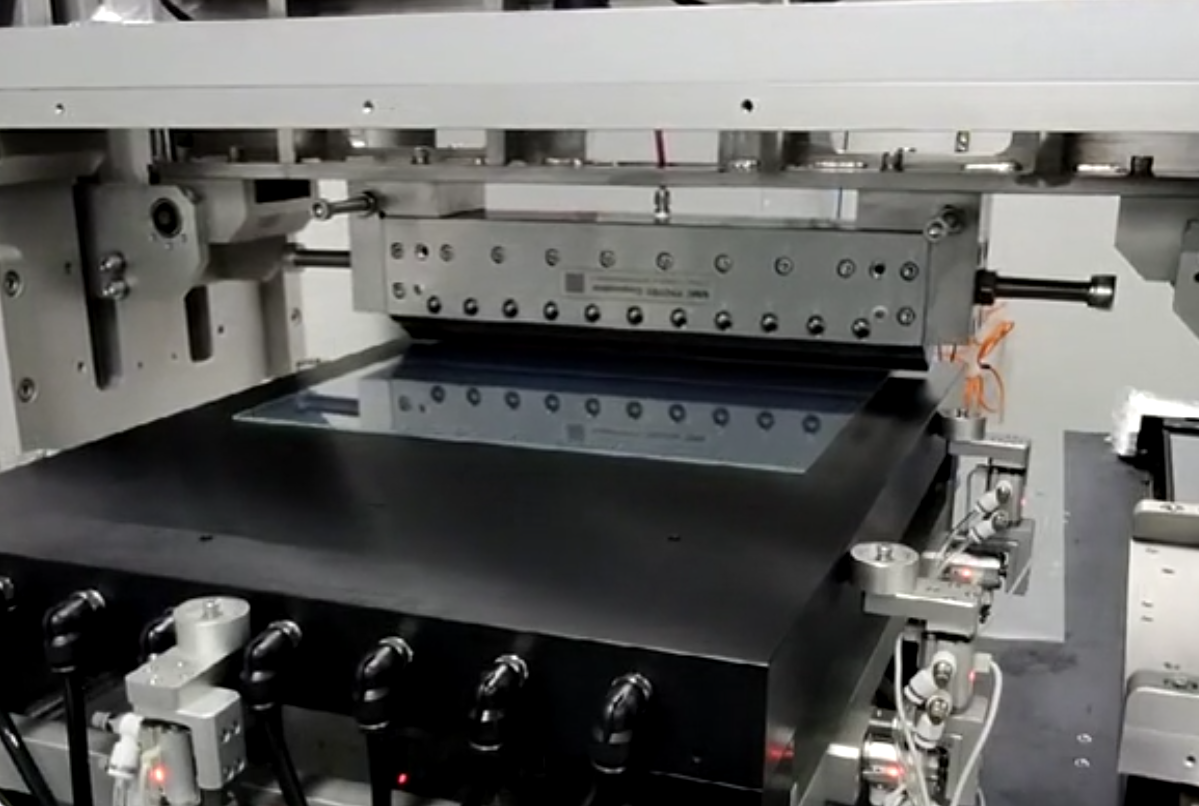
Compared with other adhesive application methods, slot-die coating offers several significant advantages in high-volume production:
High adhesive-film thickness accuracy: Coating thickness can be precisely controlled through both the shim specification and the automated adhesive feeding system. This provides excellent full-surface uniformity, with thickness uniformity reaching ±8%, effectively minimizing uneven adhesive thickness and significantly improving the optical consistency of the display.
Excellent batch-to-batch consistency: Slot-die coating effectively solves adhesive thickness fluctuations caused by positioning errors and path deviations in conventional dispensing. The coefficient of variation in adhesive-layer thickness within the same production batch is extremely low, resulting in more stable quality during mass production.
No adhesive overflow, with lower cost and higher efficiency: The closed-die coating design enables precise control of adhesive boundaries, preventing overflow at the process level. This significantly reduces subsequent manual cleaning, minimizes optical adhesive waste, and lowers manufacturing costs.
Suitable for large-format and high-throughput production: The adhesive layer can be formed in a single coating pass without repeated dispensing, making the process highly suitable for the mass production of large-format displays and automotive screens. Its production efficiency is significantly higher than that of conventional processes.
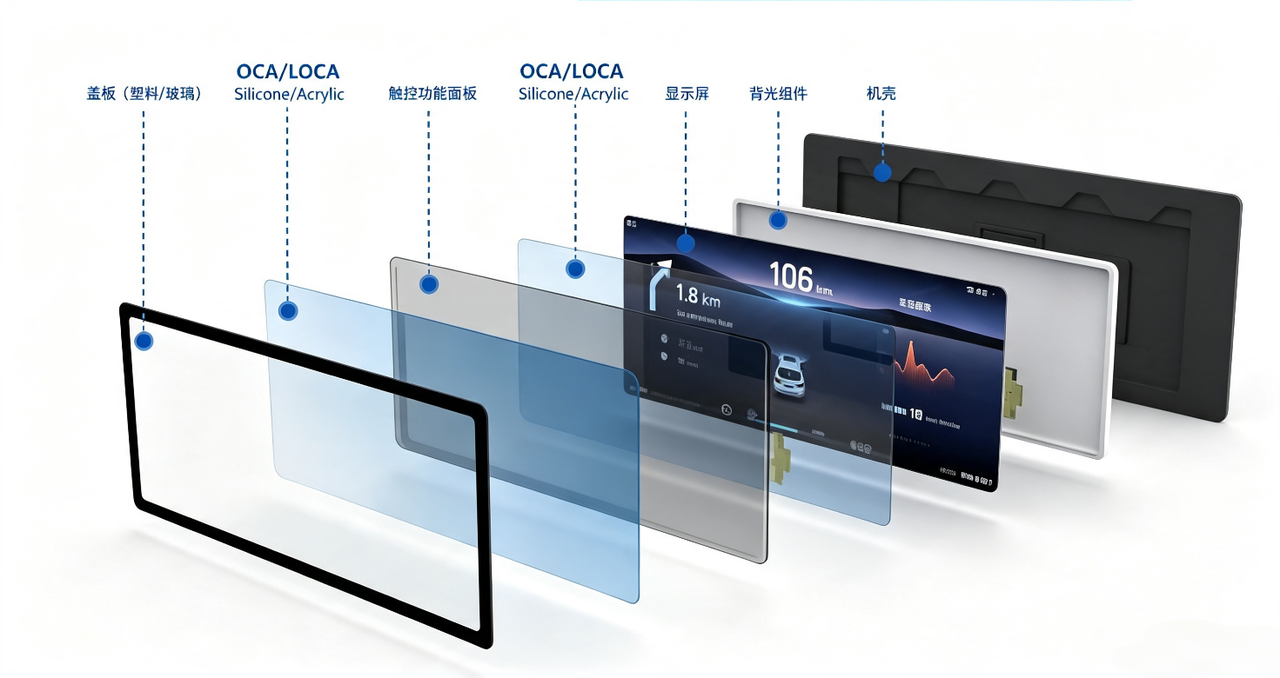
Today, slot-die coating has been widely adopted in high-end applications including automotive displays, large-format commercial displays, and industrial control displays. Based on practical industry testing, slot-die coating outperforms conventional dispensing and gap-filling processes in key mass-production indicators such as adhesive-layer thickness uniformity, overflow control, material consumption, and yield stability, making it a major trend in the upgrading of display optical bonding processes.
Introduction to Betely BTY-5218
To address the process characteristics and quality requirements of high-end slot-die coating applications, Betely New Materials has leveraged its expertise in optical adhesives to independently develop BTY-5218, a one-component silicone UV delayed-curing optical adhesive primarily used for interlayer bonding between touch glass and display modules. The product adopts a dual-curing mechanism combining UV photoactivation and thermal curing. With excellent process compatibility, it can be flexibly used with both slot-die coating and conventional dispensing, supporting mass production across a variety of application scenarios.
Key Technical Parameters
Refractive Index: 1.404
Viscosity: 8,000 mPa·s
Density: 0.97 g/cm³
Component: One-component
Gel Energy: 4,000 mJ
Supported by mature formulation development and process optimization capabilities, BTY-5218 delivers excellent performance in optical properties, reliability, process compatibility, and practical usability, making it highly suitable for the mass-production requirements of high-end display optical bonding.
1. Optical Performance and Bonding Strength
After curing, BTY-5218 provides light transmittance of over 99% and haze below 0.2%, delivering excellent optical clarity without compromising display transparency or color performance. It also provides good bonding performance on both glass and plastic substrates.
2. Automotive Reliability
Coating thickness can be precisely controlled through both the shim specification and the automated adhesive feeding system, providing excellent full-surface uniformity. Thickness uniformity can reach ±5%, effectively minimizing uneven adhesive thickness and significantly improving the optical consistency of the display.
3. Resistance to Yellowing
The product offers excellent resistance to thermal yellowing. After 150 hours of aging at 95°C, the yellowing value remains below 0.1. It is resistant to yellowing and hazing during long-term use, helping to maintain long-term optical stability throughout the service life of the display device.
4. Resistance to Cure Inhibition
To address the common industry challenge of cure inhibition at OC adhesive contact interfaces, BTY-5218 has undergone dedicated formulation optimization and offers good resistance to cure inhibition. The bonded interface remains stable, compatibility with different materials is broader, and the product can effectively reduce defect rates in mass production.
5. Mechanical Performance and Ease of Rework
Excellent mechanical properties enable the product to effectively withstand process and environmental stresses caused by high-pressure debubbling and high-temperature conditions, resulting in greater stability during mass production. In addition, the adhesive is relatively easy and efficient to remove during rework, helping minimize the risk of display breakage during the repair process.
Conclusion
As the display optical bonding industry continues to move toward higher precision, greater efficiency, lower material consumption, and higher reliability, the advantages of slot-die coating as an alternative process are becoming increasingly evident. Its key characteristics, including ±8% adhesive-layer thickness uniformity, zero adhesive overflow, and low material consumption, offer advantages that conventional dispensing and gap-filling processes cannot easily match.
Betely BTY-5218 optical adhesive is precisely aligned with the industry’s process-upgrade requirements. It combines excellent optical performance, automotive-grade reliability, resistance to yellowing, and resistance to cure inhibition, while also being highly compatible with advanced slot-die coating processes for mass production. By balancing quality and efficiency, BTY-5218 provides a stable, high-yield, and cost-effective optical bonding solution for high-end applications such as large-format displays and automotive touch displays.