As the power consumption of AI computing systems, 5G base stations, and high-power chips continues to rise, thermal management has become a critical bottleneck in realizing the full performance of electronic equipment. Drawing on more than two decades of expertise in chemical materials, Betely has developed a complete thermal grease portfolio with thermal conductivity ratings from 3.5 W/mK to 6.3 W/mK, providing systematic thermal management solutions for applications ranging from consumer electronics to industrial high-power systems.
Product Portfolio for a Broad Range of Applications
To address different power densities and application-process requirements, Betely has organized its thermal grease portfolio into a clearly tiered product range:
Model | Thermal Conductivity | Thermal Resistance | BLT | Key Features | Typical Applications |
TCC-2042 | 3.5 W/mK | 0.03℃·cm²/W | 10μm | Low thermal resistance; ultra-thin interface | Business laptops / desktop computers |
TCC-3146 | 4.4 W/mK | 0.05℃·cm²/W | 13μm | Low viscosity; easy application | Gaming laptops / general-purpose servers |
TCC-3153 | 5.4 W/mK | 0.04℃·cm²/W | 14μm | High reliability | Servers / 5G base-station BBU and RRU units |
TCC-3158 | 6.0 W/mK | 0.03℃·cm²/W | 14μm | High thermal conductivity; low thermal resistance | High-performance server GPUs / CPUs |
TCC-3251 | 6.0 W/mK | 0.02℃·cm²/W | 8μm | Ultra-low thermal resistance; ultra-thin interface | Highest power-density applications |
TCC-5061 | 6.3 W/mK | 0.03℃·cm²/W | 16μm | Pump-out resistance for bare-die applications | AI accelerator cards / high-power chips |
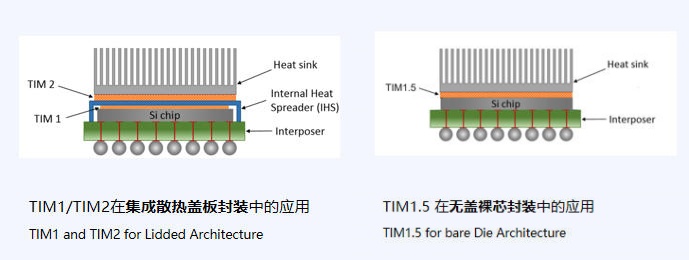
The portfolio covers the two mainstream architectures of TIM1.5 for lidless bare-die packages and TIM2 for packages with an integrated heat spreader. Thermal grease fills microscopic air gaps between the heat sink and the chip surface, creating an efficient path for heat transfer.
TCC-20XX Series: Designed for Power Electronics and High-Voltage Applications
In addition to the TCC-30XX/50XX series for 3C electronics and AI computing applications, Betely also offers the TCC-20XX series of thermal greases, primarily for power-electronics applications such as photovoltaic inverters, IGBT modules, and energy-storage power conversion systems.
Model | Thermal Conductivity | Thermal Resistance | BLT | Key Features | Typical Applications |
TCC-2030 | 3.5 W/mK | 0.23℃·cm²/W | 44μm | Cost-effective; general-purpose grade | Low-power inverters |
TCC-2046 | 4.0 W/mK | 0.18℃·cm²/W | 44μm | Balanced overall performance | Medium-power power electronics |
TCC-2050 | 6.0 W/mK | 0.10℃·cm²/W | 50μm | High thermal conductivity; high dielectric strength | High-power IGBT modules / inverters |
The TCC-20XX series offers the following differentiated advantages:
● High dielectric strength: Dielectric breakdown strength reaches up to 8.5 kV/mm, making the series suitable for high-voltage applications such as photovoltaic inverters and IGBT modules.
● High thixotropic index: TCC-2030 has a thixotropic index of 4.2 and TCC-2050 reaches 2.6, providing excellent compatibility with screen-printing and dispensing processes.
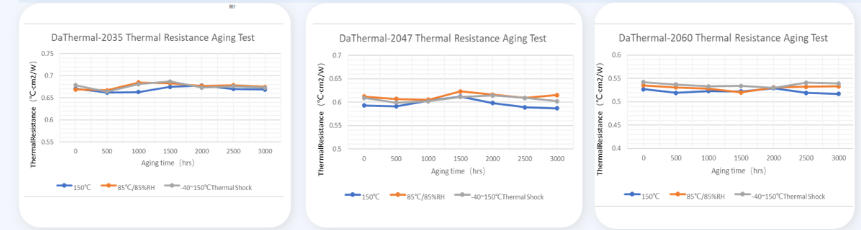
● Long-term reliability: After 1,000 hours of high-temperature/high-humidity exposure and thermal-shock testing, the materials showed no slippage, cracking, or bubbles.
● Stable thermal resistance at high temperature: Thermal resistance remained stable during aging at 150°C, meeting the long-term operating requirements of power-electronics equipment.
Selection guide: The TCC-30XX/50XX series provides lower thermal resistance (0.02-0.05°C·cm²/W) and a thinner BLT (8-16 μm), making it suitable for CPU, GPU, and AI chips that are highly sensitive to thermal resistance. The TCC-20XX series offers higher dielectric strength (≥8.5 kV/mm) for power-electronics applications such as IGBT modules and inverters, where electrical insulation performance is a defined requirement.
Key Technical Advantages
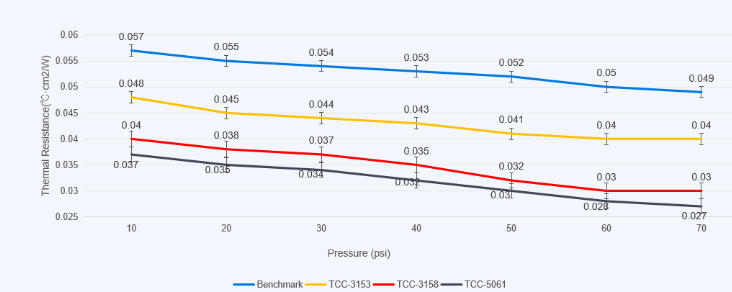
1. Low thermal resistance design: TCC-3251 achieves thermal resistance as low as 0.02°C·cm²/W, with BLT controlled to 8 μm. At 40 psi, the thermal resistance of TCC-3153, TCC-3158, and TCC-5061 is approximately 19%, 33%, and 40% lower, respectively, than that of the benchmark product
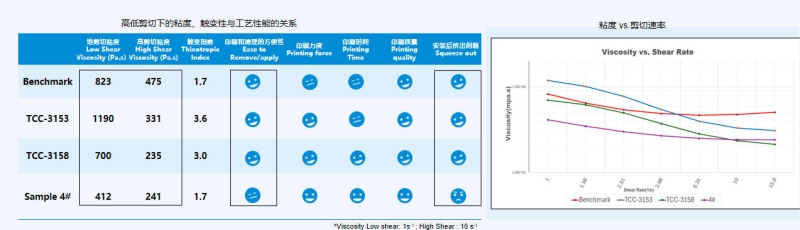
2. Optimized rheology: Test data show that TCC-3153 and TCC-3158 have thixotropic indices of 3.6 and 3.0, respectively, and high-shear viscosities of 313 Pa·s and 235 Pa·s, outperforming the benchmark values of 1.7 and 475 Pa·s. The high-thixotropy design reduces the required printing force and enables faster printing while helping prevent squeeze-out after assembly. Comparative Sample 4# has a thixotropic index of only 1.7 and relatively low viscosity under both low- and high-shear conditions, making it more likely to drip from the squeegee, contaminate the screen, and squeeze out after assembly.
3. Damp-heat aging resistance: After screen printing, TCC-3153 and TCC-3158 were aged for 1.5 months at 85°C/85% RH. Their pressure-induced spreading performance continued to meet process requirements and remained comparable to the benchmark sample. Under the same conditions, competing product TC-5026 failed after one month of aging.
4. Stable thermal resistance at high temperature: During aging at 150°C, TCC-3153 and TCC-3158 maintained stable thermal resistance, whereas the thermal resistance of Comparative Sample 4# increased progressively with aging time.
5. Environmental compliance: All products in the portfolio use solvent-free formulations and comply with RoHS and REACH requirements. Volatile content after 24 hours at 150°C is controlled within the range of 0.07%-0.192%.
R&D Progress
To address applications with even higher power density, Betely is advancing the following R&D projects:
● LMC-307X liquid-metal thermal paste: Thermal conductivity of 7.2 W/mK and thermal resistance of 0.01-0.02°C·cm²/W. In testing on an RTX 4090 chip, it reduced chip temperature by approximately 1°C compared with TCC-3251 and has passed 5,000 thermal cycles.
● TCG-701X low-thermal-resistance curable thermal gel: Thermal conductivity of approximately 7.0 W/mK and thermal resistance of approximately 0.02°C·cm²/W.
● MPC-306X modified phase-change material: Thermal conductivity of approximately 6.5 W/mK and thermal resistance of approximately 0.03°C·cm²/W.
The performance of thermal grease cannot be judged by thermal conductivity alone. Along the heat-transfer path from the chip to the heat sink, every factor - including thermal resistance, BLT, rheology, and long-term aging stability - has a direct impact on final cooling performance. Betely's thermal grease portfolio comprises three major series: TCC-20XX for power electronics and high-dielectric-strength applications, TCC-30XX for 3C electronics and general-purpose servers, and TCC-50XX for AI computing and pump-out resistance. A complete set of technical parameters and traceable test data provides customers with a clear basis for product selection and validation.
Coming in the next issue: Thermal Gels - A Thermal Management Choice for New-Energy Applications and Precision Electronics